One of the most talked about documentaries in the plant based world is "COWSPIRACY: The Sustainability Secret," and last night I finally watched it. Due to its recent unveiling on Netflix, I felt a good way to kick off its career was to review it. I was not sure what to expect from the film, based on the many people raving about it I assumed that it would be along the lines of "Earthlings," which is why I put it off for so long because I wasn't prepared to go through something so heavy again. However, I was pleasantly surprised to find that the film had a healthy dose of humor and centered mainly along the lines of environmentalism and how food animal production has on the planet and the imminent threat that eating animal products causes.
If you enjoyed "Vegucated," "Fat, Sick, and Nearly Dead," or other films that follow a specific person's journey, you will love this film. It follows the directors, Kip Anderson and Keegan Kuhn, as they travel to the different head quarters of big environmental groups like Green Peace, the Sierra Club, and the Surfrider Foundation to ask for opinions on the impact raising cows has on the planet and what can be done to reduce it. However, none of the organizations are willing to admit that agribusiness is the main issue, instead they focus on fossil fuels, palm oil, and coal.
This film is a wake up call to any and all people; environmentalists, big business, farmers, teenagers, everyone inhabiting the Earth. It is chock full of facts that are broken down in an easy, understandable, and entertaining way, as well as plenty of non-aggressive warnings about the overuse of land, the dead zones in the oceans, deforestation, and the very real threat that pollution is providing.
If you are considering switching to a plant based lifestyle but can't seem to motivate yourself to do so, watch this film. If you are already plant based and want to know more about your carbon footprint, watch this film. If you are simply looking for an educational film, watch "Cowspiracy."
I honestly cannot stress enough how important it is that this film is spread around and watched by as many people as possible. It is very well done, it is very entertaining, and its message is so damn important.
As of today, September 15, 2015, "Cowspiracy" is available on Netflix streaming. If you do not have Netflix you can buy the DVD or the download on their website. And if you absolutely don't want to spend money on the film but still want to watch it I'm sure there are websites where you can find the movie for free (although I strongly advise against it because Keegan and Kip could use all the help they can get and buying the film or watching it on Netflix are the best ways to do that).
Translate
Showing posts with label education. Show all posts
Tuesday, September 15, 2015
COWSPIRACY: The Sustainablility Secret (And Why You Should Watch It)
Labels:
agribusiness,
conservation,
cows,
Cowspiracy,
documentary,
earthlings,
education,
environmentalism,
Leonardo DiCaprio,
movie review,
ocean,
plant based,
pollution,
preservation,
rainforest,
speciesism,
vegan,
veganism
Thursday, June 25, 2015
Animal Dissections in Schools: a Debate
A month or so ago I posted a quick take on the video of Oklahoma students performing a dance routine with the bodies of cats intended to be used for educational purposes (see that post here), and today I am going to attempt to shed a little more light on the subject. Dissection of animals in the classroom has become a rather touchy subject throughout recent years. Debates have become quite heated as the treatment and production of the donated animals, as well as the actual necessity of the activity and how comfortable the students themselves are with the process. So let's dive in: The pros and cons of animal dissections in schools and why, ultimately, I believe that the activity should be banned.
We will begin with the positive effects of using real animals for scientific studies in schools. To begin with, studies have shown that many students better absorb the material being taught to them when they have hands-on experience. By dissecting the actual animal in their textbooks, they are able to comprehend the structures and functions of the body systems more easily than in a slideshow presentation, worksheet, or video. Others argue that once the animal is dead, why waste its body by simply disposing of it instead of using it to further our children's knowledge of the workings of the natural world around them. Another argument is that it is an experience, similar to a tradition or right of passage, and an important part of a student's life. I am not going to discount the importance of experiences in a person's life and how they shape them. I myself dissected a cow bone in the third grade, as well as two rats in my high school career. However, in my personal experience, these activities could have been just as easily completed on paper or virtually, as I had a solid comprehension of the material we were being taught and the formaldehyde fumes made me light-headed. Experiences are very important in a person's life, especially the developing youth that are going to shape the future of our world, and I am no one to discount that. However I do not believe that education should be the reason for any kind of suffering, and on that note, we move into the arguments for the banning of dissections in schools.
In my previous post about the students in Oklahoma, we witnessed the abuse of the bodies of cats that were intended for educational use. This is not an exception, this is not the only case. Students from Newport Harbor High School "were pictured [online] posing with the dead animals. One student held up a cat's head and pretended to lick it. The head of another turned up in a student’s locker," reported the Pacific Standard.
The bodies of these animals are being abused by some teenagers, and causing emotional harm to others. In some schools, students are not given the option to opt out of dissecting animals, no matter how squeamish or uncomfortable they may feel. The acquisition of animals for these classes is not always honest. Yes, there are companies who breed animals specifically to donate their bodies to science, but there are also "donations" from pounds and pet shelters, slaughterhouses, pet stores, and even companion animals who "escaped" from their homes. Sometimes the animals are not dead when they are injected with formaldehyde, and must suffer a slow and painful death at the hand of the chemical. Others are cruelly killed by the workers in supply factories. PETA describes an instance where "one rabbit, still alive after being gassed, tried to crawl out of a wheelbarrow full of water and dead rabbits. Employees laughed as a coworker held the rabbit’s head underwater and pulled him out just as death seemed near, repeating the process again and again until, bored with the “game,” the employee held the animal’s head underwater long enough to drown him." These acts are horrific and the "educational experience" provided from the bodies of these abused earthlings is not even close to being worthy of their suffering.
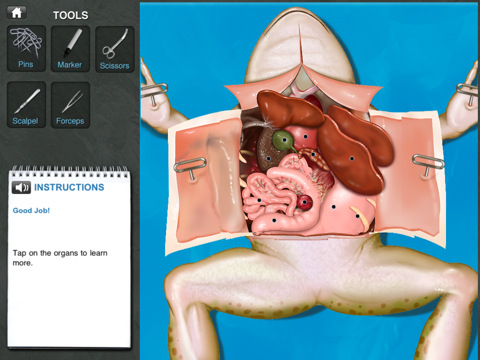
Banning dissection programs is not the same as depriving the students from an important biological lesson, there are plenty of cruelty-free options and programs designed to give the students a comprehensive understanding of the inner workings of organ systems. PETA provides a list of good programs here. These virtual animals provide the students with the option to complete the dissection without the needless death of an animal, as well as provide the more sensitive students with a preferred alternative to the real thing.
I understand that not all schools may be able to afford enough computers for students to run these programs, and that is not the school's fault. I do however, believe that the killing of innocent creatures for the purpose of elementary science is not necessary. Cruelty is not a necessary part of learning, and if anything should be minimalized in the educational system.
To learn more check out:
PETA
Debate
NEAVS
NAVS
Pacific Standard
NSTA
| Photo from pragmaticmom.com |
In my previous post about the students in Oklahoma, we witnessed the abuse of the bodies of cats that were intended for educational use. This is not an exception, this is not the only case. Students from Newport Harbor High School "were pictured [online] posing with the dead animals. One student held up a cat's head and pretended to lick it. The head of another turned up in a student’s locker," reported the Pacific Standard.
The bodies of these animals are being abused by some teenagers, and causing emotional harm to others. In some schools, students are not given the option to opt out of dissecting animals, no matter how squeamish or uncomfortable they may feel. The acquisition of animals for these classes is not always honest. Yes, there are companies who breed animals specifically to donate their bodies to science, but there are also "donations" from pounds and pet shelters, slaughterhouses, pet stores, and even companion animals who "escaped" from their homes. Sometimes the animals are not dead when they are injected with formaldehyde, and must suffer a slow and painful death at the hand of the chemical. Others are cruelly killed by the workers in supply factories. PETA describes an instance where "one rabbit, still alive after being gassed, tried to crawl out of a wheelbarrow full of water and dead rabbits. Employees laughed as a coworker held the rabbit’s head underwater and pulled him out just as death seemed near, repeating the process again and again until, bored with the “game,” the employee held the animal’s head underwater long enough to drown him." These acts are horrific and the "educational experience" provided from the bodies of these abused earthlings is not even close to being worthy of their suffering.
Banning dissection programs is not the same as depriving the students from an important biological lesson, there are plenty of cruelty-free options and programs designed to give the students a comprehensive understanding of the inner workings of organ systems. PETA provides a list of good programs here. These virtual animals provide the students with the option to complete the dissection without the needless death of an animal, as well as provide the more sensitive students with a preferred alternative to the real thing.
I understand that not all schools may be able to afford enough computers for students to run these programs, and that is not the school's fault. I do however, believe that the killing of innocent creatures for the purpose of elementary science is not necessary. Cruelty is not a necessary part of learning, and if anything should be minimalized in the educational system.
| Photo from veganbean.com |
To learn more check out:
PETA
Debate
NEAVS
NAVS
Pacific Standard
NSTA
Labels:
activism,
animal news,
animal rights,
animal welfare,
biology,
cats,
dissection,
earthlings,
education,
frogs,
global,
PETA,
science,
vegan,
veganism,
vegetarian
Subscribe to:
Posts (Atom)